By Blossom Knight December 19, 2025
Long-term stability, improved client relations, and consistent revenue are all promised by membership programs. However, the majority of memberships fail because the structure disregards how people really live, not because the product is poor. Customers cancel because the membership no longer fits their reality, not because they despise the brand.
Members are subtly turned off by poorly constructed levels, strict regulations, unclear perks, and a lack of flexibility. Discounts are not the only factor that influences retention. Relevance, trust, and emotional alignment are its driving forces. A “stick” membership adjusts to shifting financial cycles, schedules, and levels of motivation. It takes operational discipline, empathy, and thought to design for stickiness.
Businesses may create tiers, benefits, and pause alternatives that seem encouraging rather than constrictive when they comprehend why members depart within the first ninety days. Strong memberships don’t trap customers. They earn loyalty through thoughtful design.
Designing Membership Tiers That Make Sense

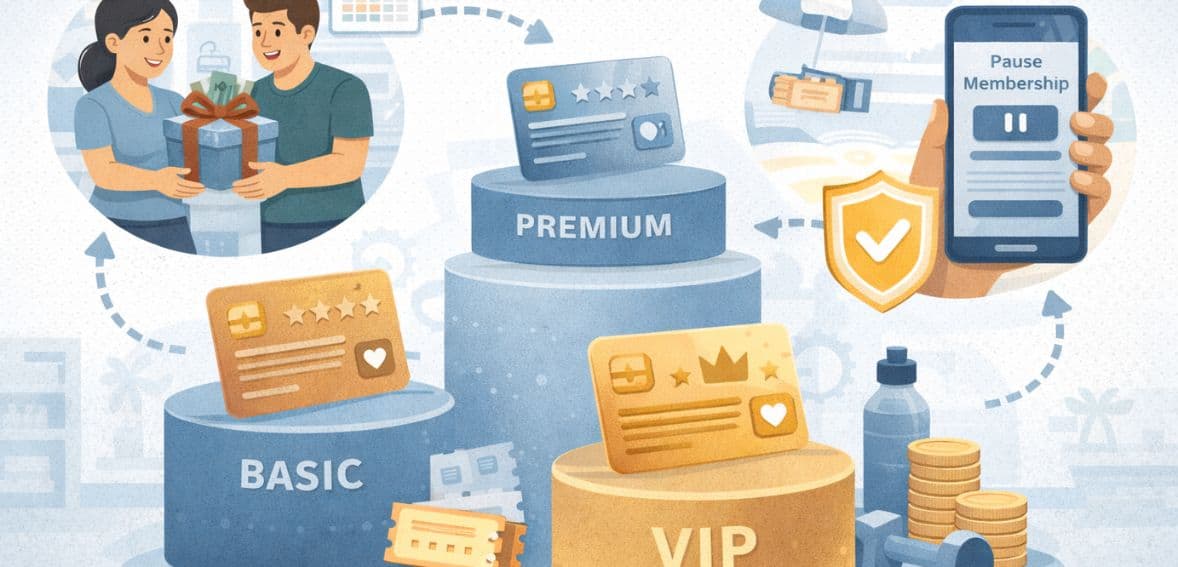
Membership tiers need to make selection easier rather than more difficult. Customers become overwhelmed by too many alternatives, delaying commitment. People are forced into plans that don’t suit their consumption since there aren’t enough alternatives. Real consumer behaviour, not organizational price objectives, is reflected in an effective tier design.
Each tier must represent a clear lifestyle use case, not just a price jump. Customers should instantly understand who each tier is for. The target audience for each tier should be immediately apparent to customers. Members downgrade or quit completely when tiers seem arbitrary.
Instead of focusing only on features, sticky memberships link levels to frequency, ease, and access. A well-thought-out tier ladder softly promotes advancement without applying pressure. Moving up should not seem like a forced upsell, but rather like a natural progression. Customers self-select confidently and stay longer when levels are intuitive since the membership reflects their actual habits and expectations.
Avoiding the “Middle Tier Trap”
Churn is frequently highest in the middle tier. Customers view it as indecisive, while businesses create it as a compromise. It often provides too much to seem necessary and too little to feel premium. Middle-tier members frequently believe they are either overpaying or losing out. The probability of cancellation is increased by this internal disagreement. The intermediate layer must support a distinct, recognizable member identity to escape this trap.
While still being significantly different from the top tier, it should be able to address a specific issue more effectively than the entry tier. The intermediate tier becomes a short-term stay rather than a long-term residence because it lacks a purpose. Every tier has emotional clarity thanks to sticky memberships. Members should never question if they made the right decision. Confidence in choice directly supports retention.
Pricing Psychology and Perceived Fairness
Pricing is about justice as much as affordability. When members feel valued and understood, they are willing to pay more. Confusing pricing structures erode trust, especially when benefits feel misaligned with cost. Instead of using random numbers to anchor price, sticky memberships use value signals.
While usage-based limits appear flexible, round pricing frequently feels predictable. Suspicion is decreased when pricing disparities are explained openly. Members are always doing mental math. Churn risk rises if customers believe they have to “work” to justify the price. Instead of being pushy, pricing should feel reasonable and balanced.
Consistency is another aspect of fairness. Loyalty is harmed by abrupt, unjustified increases. Members choose experience above cost when prices seem reasonable and consistent. A psychological contract known as perceived fairness sustains memberships even in the face of shifting motives.
Perks That Actually Influence Behaviour
Benefits are only significant if they change behaviour. Benefits appear great on paper, but are never utilized, which is why many memberships fail. Simple, easily accessible, and instantly satisfying are sticky advantages. Convenience improvements, time-saving measures, and priority access frequently overtake showy bonuses.
Benefits that make their life easier are valued by members. Benefits are underutilized when they call for preparation or additional work. Perceived value is subtly undermined by unused benefits. Perk usage should be routinely audited by companies, and those that don’t increase engagement should be eliminated. Routine is reinforced by effective benefits.
They motivate members to participate, check in, or show up more frequently. Cancellation seems more like losing a convenience than a subscription when benefits are incorporated into a habit loop. Passive members become active participants when they get behaviour-driven benefits.
Onboarding as a Retention Tool

Onboarding is a retention strategy rather than an introduction. Before they actively consider canceling, members determine how long they want to stay. Members who get inadequate onboarding are unclear of how to utilize their purchases. Instead of seeing onboarding as a checklist, sticky memberships view it as a guided experience.
Anxiety is decreased by early encouragement, clear explanations, and clear initial steps. Members should understand the importance of their first week and exactly what to do. After signing up, silence breeds doubt. Members are reassured that they made the proper decision through frequent touchpoints. Even if onboarding is automated, it should still seem human.
Members get emotional momentum when they are acknowledged and encouraged early on. They don’t doubt the membership’s worth during times of less usage because of that momentum. Clear onboarding also includes documenting expectations through digital consent, which helps members understand terms, benefits, and pause options from the start while reducing confusion later in the membership lifecycle.
Preventing “Silent Churn” Before It Happens
When members stop participating long before they cancel, it’s known as silent churn. They mentally distance themselves, cease using perks, and disregard messages. It is impossible to recover by the time cancellation occurs.
Sticky memberships are early indicators of disengagement. Warning flags are revealed by usage trends, login frequency, and missing encounters. At this point, proactive outreach feels more encouraging than reactive. Interest may be rekindled with simple check-ins, reminders of underused advantages, or modest rewards.
Recovery is usually more difficult than prevention. Businesses have already lost emotional connection while they wait for cancellation notifications. Prior to members speaking, retention systems must listen. Early intervention reframes the membership as alert and responsive. When members feel noticed, they are more tolerant. It takes focus, not pressure, to prevent silent churn.
Communication That Builds Belonging
Members remain devoted to their identities rather than to pricing schemes. A key factor in forming that identity is communication. Instead of just promotions, sticky memberships provide a sense of purpose, advancement, and community. Frequent updates must reinforce the purpose of the membership and how members gain from it outside of purchases.
Over-communication causes distance, whereas overcommunication overwhelms. Relevance is where the balance is found. Instead of being sales-oriented, messages should seem current and beneficial. Members reciprocate with trust when communication feels human.
Members’ sense of belonging increases when they are a part of something continuous rather than a recurring expense. Emotional connection is influenced by even basic linguistic decisions. Members’ loyalty is strengthened, and the temptation to cancel during uncertain times is decreased when communication recognizes them as unique people.
Managing Expectations Around Results

Retention is destroyed by unrealistic expectations. Real life falls short of marketing’s promises of instant change. Honest timelines are communicated through sticky memberships. Results-based services need to make clear what progress looks like and how long it takes. Frustration is decreased by controlling expectations.
When they comprehend the procedure, members can cope with delayed advancement. Doubt arises from silence. Momentum is strengthened by consistent progress indicators. Small victories should be celebrated by businesses instead of overall results. When promises and experiences align, trust is strengthened.
Aligning perception with reality is the goal of expectation management, not decreasing standards. Members are more patient when they feel educated rather than duped. When expectations are well-founded and reinforced by regular communication, retention increases.
Handling Price Sensitivity Without Devaluation
Price resistance is not the same as price sensitivity. Members object to feeling overpriced and unfairly rewarded. Instead of using discounts to address sensitivities, sticky memberships use alternatives. Value is maintained without damaging brand impression through tier flexibility, brief pauses, or substitute advantages.
Members learn to wait rather than commit when they receive ongoing discounts. Rather, companies ought to promote value narratives. Members become less sensitive when they know what they’re paying for and why it matters. Open communication about financial difficulty builds trust.
Maintaining dignity requires quiet accommodation. When companies respect both their own positions and the budgets of their customers, retention increases. Price flexibility should come out as encouraging rather than frantic. Perceived justice, not ongoing rewards, determines long-term stickiness.
A well-structured subscription billing system helps businesses manage pauses, upgrades, and billing adjustments without confusion, preserving perceived fairness while accommodating changing member needs.
Internal Alignment and Staff Impact

Marketing is not only responsible for retention. Every day, frontline employees influence members’ experiences. Internal agreement on rules, tone, and adaptability is necessary for sticky memberships. Members get confused and lose trust as a result of conflicting information.
Employees should have a thorough understanding of pause rules, benefits, and tiers. Employees who are empowered address problems before they become more serious. Members feel comforted when employees are comfortable explaining the benefits of membership. Churn on the outside is a direct result of inside perplexity.
Alongside policy, empathy should be emphasized in training. Employees who support the membership concept convey it genuinely. Alignment increases loyalty, enhances consistency, and lowers friction. When internal performance deviates from external promises, retention methods fail.
Measuring Retention Beyond Cancellation Rates
The cancellation rate by itself is not the whole picture. Sticky memberships monitor metrics for satisfaction, usage frequency, and engagement. Future churn is predicted by early disengagement. Proactive action is made possible by measuring these signals. Retention is not a binary result, but rather a spectrum.
Companies should keep an eye on how members utilize benefits, switch between levels, and react to messages. Friction points are shown via patterns. Qualitative comments should be combined with quantitative data.
Surveys and conversations provide context behind numbers. Retention techniques become more accurate as measurement gets more comprehensive. Knowing why members remain is just as crucial as understanding why they depart. Longer-lasting memberships and better design choices are the results of improved measurement.
Scaling Memberships Without Losing Stickiness
Complexity is frequently introduced by growth. By maintaining clarity, sticky memberships grow. Adding levels, benefits, or regulations should make things easier rather than more difficult. As traffic rises, systems must continue to be intuitive. Instead of taking the place of customization, automation should enhance it. Scaling retention necessitates the broad use of consistent concepts.
Companies have to record what makes memberships endure and purposefully duplicate those components. Lifetime value is rapidly reduced when stickiness is lost at scale. Strengths should be enhanced rather than diminished by growth. Retention is high when scalability honors the original design goal. Maintaining the member experience while operations grow is a key component of effective scaling.
Future-Proofing Membership Design

Consumer expectations are always changing. Instead of responding to change, sticky memberships anticipate it. Empathy, openness, and flexibility are ageless. Although technology may change, human behaviour never changes. Future-proof memberships prioritize flexibility above strict optimization.
Relevance is ensured by frequent assessments. One way to prevent stagnation is to listen to members. Companies that continue to be interested in their target market develop organically. Predicting trends is not the goal of future-proofing; rather, it is about creating systems that can adapt to them. Memberships that adjust well withstand changes in the market and pressure from competitors.
Conclusion: Designing Memberships That Truly Stick
Sticking memberships are not accidental. They are not only price models; they are purposefully built around human behaviour. When levels make sense, benefits shape habits, and pause rules honor reality, retention increases. Long-term loyalty depends on continued alignment, but the first ninety days are crucial.
Instead of imposing uniformity, sticky memberships change with their clientele. They place a high value on flexibility, justice, and clarity. Churn becomes controllable rather than unavoidable when companies create with empathy and discipline. Strong memberships don’t depend on compulsion. Relevance and trust are how they gain commitment. Memberships that seem human are the ones that really stick in a crowded market.
FAQs
What is the most overlooked cause of early membership churn?
Poor expectation setting in the first 30 days, especially unclear usage guidance and hidden friction.
How do pause options impact lifetime value without hurting revenue?
Pauses prevent full cancellations during temporary life disruptions, preserving long-term member relationships.
Why do complex tier structures increase churn instead of conversions?
Too many choices create decision regret, causing members to second-guess and exit early.
Which perks consistently outperform discounts in retention?
Convenience-based perks that reduce effort, time, or scheduling friction drive stronger habit formation.
How can businesses detect churn risk before a cancellation happens?
By monitoring engagement drop-offs, unused benefits, and behavioural silence—not just billing activity.
Leave a Reply